

This guide examines the latest commercial kitchen fire statistics UK restaurant operators need to understand, including the leading causes, legal responsibilities and financial consequences of serious fires.
What the Latest Fire Data Reveals About UK Commercial Kitchens
Commercial kitchens are among the highest-risk fire environments in the hospitality sector. High-temperature cooking, hot fats and oils, electrical equipment and grease accumulation within extraction systems all create opportunities for ignition.
Once a fire enters grease-contaminated canopies, fans or ductwork, it can become extremely difficult to locate and control. In many UK buildings, extraction ductwork extends through several storeys, passing close to offices, flats and other occupied areas before reaching the roof. This creates the potential for serious structural damage and danger to life, particularly in older buildings with complex layouts and limited access.
Real incidents at well-known venues, including Lore of the Land, TGI Fridays in Edinburgh and Rodizio Rico at The O2 Arena, demonstrate how devastating commercial kitchen fires can be. You can read more about these real incidents on our website here.
This guide brings together the latest available official data and industry evidence on restaurant and kitchen fires, including their frequency, leading causes, legal responsibilities, arson risk and recent enforcement activity. Where figures relate specifically to England rather than the whole of the UK, this is clearly stated.
Commercial Kitchen Fire Statistics UK: Key Figures and Risks
These commercial kitchen fire statistics show why UK restaurants, takeaways and catering premises need robust fire prevention and extract hygiene procedures.

These figures are the latest available from official UK statistics, and this page is reviewed and updated as new data is published. Source: Fire Marshal Training.
Restaurant and Kitchen Fires Remain a Persistent Commercial Risk
Fire and rescue services in England attended 1,275 fires in food and drink premises during 2024/25. The sector accounts for approximately 19% of workplace fires and ranks as the second-highest-risk workplace category, behind industrial premises.
This elevated risk reflects the conditions found in commercial kitchens. Restaurants, takeaways and catering premises combine sustained high temperatures with hot cooking oils and fats, powerful electrical and gas appliances, and grease accumulation inside canopies, filters, fans and extract ductwork.
Busy service periods can increase the danger further. Under pressure, routine cleaning, equipment checks and safe working procedures may be delayed or overlooked, allowing combustible grease and other hazards to build up.
Although workplace fires have fallen by approximately 29% over the past decade, commercial kitchens remain a consistently high-risk environment. The combination of frequent ignition sources, flammable materials and concealed grease deposits means that a small cooking fire can quickly develop into a serious incident affecting the entire premises.
Commercial Kitchen Fire Causes
Cooking is the leading cause of restaurant fires, accounting for approximately 25% of incidents. It is also a major ignition source in care homes, where cooking is linked to around 41% of fires.
Commercial kitchens contain several overlapping fire hazards. High temperatures, flammable oils, grease deposits, extraction ductwork and heavily used electrical equipment can allow a small incident to escalate quickly.
Cooking Fat and Oil Fires
Hot cooking fats and oils can ignite when they reach their ignition temperature. These fires require a suitable Class F extinguisher. Water and unsuitable extinguishers should never be used because they can spread burning oil and cause a violent flare-up.
Grill and Fryer Fires
Fryers and grills operate at consistently high temperatures and generate significant amounts of grease. Effective temperature control is essential because overheated oil can self-ignite, particularly where thermostats, safety cut-outs or equipment are poorly maintained.
Oven and Range Fires
Food debris, grease and fat can accumulate around burners, heating elements and inside ovens or ranges. These deposits provide a ready source of fuel and can ignite when exposed to sustained heat or open flames.
Grease-Contaminated Extraction Systems
Airborne grease can collect inside filters, canopies, fans and extract ductwork. If flames enter the system, these deposits can ignite and create a concealed route for fire to spread beyond the kitchen.
Professional inspection and cleaning are commonly required by insurance every three to twelve months, depending on the type of cooking, hours of operation and level of grease production.
Electrical Faults
Commercial kitchens rely on heavily used electrical appliances, often in hot and humid conditions. Damaged wiring, overloaded circuits, faulty equipment and inadequate maintenance can all create ignition sources.
Regular inspection, servicing and prompt repair by competent professionals are essential for reducing electrical fire risk.
Legal Requirements for Restaurant Fire Safety
Under the Regulatory Reform (Fire Safety) Order 2005, the responsible person for a restaurant, takeaway or catering premises must manage fire safety through a clear and documented process.
Core legal duties include:
- Completing and regularly reviewing a suitable and sufficient fire risk assessment.
- Installing, testing and maintaining appropriate fire detection and warning systems.
- Arranging professional inspection and cleaning of kitchen extraction systems and ductwork at suitable intervals.
- Providing staff with fire safety training, including guidance on evacuation procedures and the correct use of fire extinguishers.
- Appointing enough trained fire marshals or fire wardens to support fire prevention and assist with evacuation.
Fire safety audit results show why these duties matter. In England, approximately 58% of fire safety audits carried out during 2024/25 were judged satisfactory. This means a substantial proportion of audited premises did not fully meet the required standard.
The Cost of Non-Compliance
The financial consequences of a serious fire can be substantial. UK business fire insurance claims total approximately £940 million each year, while the average cost of a major business fire is estimated at around £657,074.
For restaurants and catering businesses, the cost of a suitable fire risk assessment, regular maintenance and properly trained fire wardens is small when compared with the potential losses caused by fire, business interruption, enforcement action and reputational damage.

Ecofleece Filters: Smarter Grease Control at Source
Commercial kitchen fire safety depends on more than responding to grease after it has accumulated. A preventative approach starts by capturing airborne grease at canopy level, before it can travel into concealed ductwork, extract fans and rooftop components.

Ecofleece Filters® uses a three-part commercial kitchen filtration system consisting of a frame, a metal baffle filter and a disposable 100% wool filter pad. Together, these components capture significantly more grease-laden vapour than a conventional metal baffle filter alone.
Ecofleece wool filter pads capture up to 98% of airborne grease* at source under tested conditions, significantly reducing the amount of combustible grease entering the extraction system. This can help lower grease-related fire exposure, protect fans, fire suppression and downstream equipment and support a cleaner, more manageable kitchen extract system.
Each replaceable Ecofleece wool filter pad is made from 100% natural wool. Wool has fibre properties that help capture and retain grease, while also providing a renewable alternative to synthetic filtration materials. The wool itself is natural and biodegradable, although used pads must be handled and disposed of appropriately because they contain captured fats, oils and grease.
Reactive Cleaning Vs Preventative Management
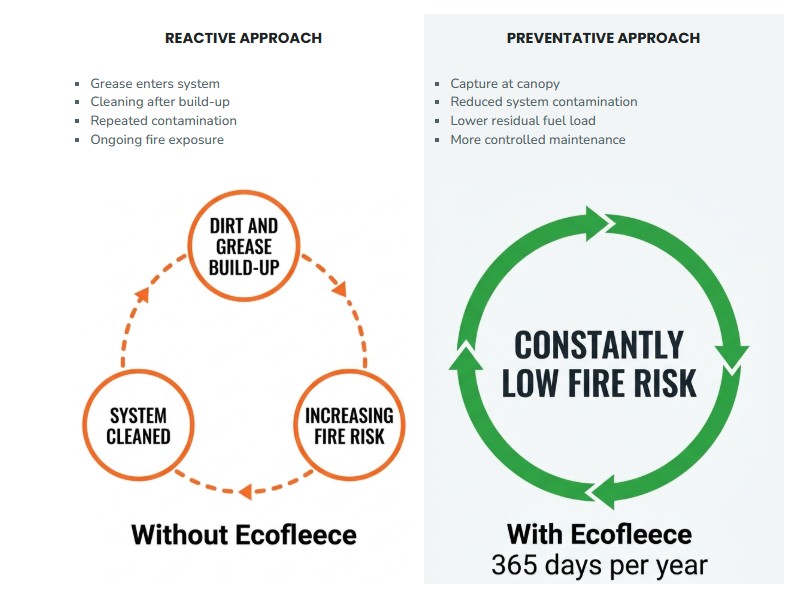
The image (above) highlights the clear difference between a reactive and preventative approach to commercial kitchen grease management. Without Ecofleece, grease can enter the extraction system, leading to repeated contamination, frequent cleaning, and an ongoing cycle of increasing fire risk. By capturing grease at the canopy, Ecofleece helps reduce contamination in the ductwork, lower the residual fuel load, and make maintenance more controlled. This preventative approach supports a consistently lower fire risk throughout the year, helping commercial kitchens improve safety, reduce disruption and protect both staff and premises.
Protecting the places you cannot easily reach IN COMMERCIAL KITCHENS

"Many of our venues are in Victorian buildings, with extraction systems hidden in basements, on rooftops or up to six storeys high, making them difficult to access and maintain. For us, Ecofleece Filters are about safety, helping to protect cleaned and TR19-certified systems by minimising grease build-up and safeguarding both new and ageing ventilation equipment."
Graeme Windsor, Kitchens Operations Manager, Signature Group
Supporting a Stronger Compliance Strategy
Ecofleece can form part of a structured fire-risk and extract-hygiene programme by helping operators:
- Reduce grease accumulation inside canopies, fans and ductwork.
- Support TR19-aligned inspection, monitoring and maintenance routines.
- Improve the visibility and control of grease loading.
- Maintain clearer inspection, cleaning and maintenance records.
- Demonstrate a proactive approach to grease-related fire-risk management.
- Support insurer, facilities-management and responsible-person requirements.

Ecofleece is UL 1046 compliant and independently tested by Intertek/ETL for use within commercial kitchen extract systems. Its 100% wool filter pads provide an additional layer of grease capture while supporting a preventative approach to extract-system safety.
From Farm to Filter: Renewable Wool with a Traceable UK Supply Chain

Ecofleece Filters use natural wool filtration media sourced through a transparent and responsible supply chain supported by The Woolkeepers®. The wool is sourced from Responsible Wool Standard certified farms, with ecological outcomes independently verified through the Savory Institute’s Ecological Outcome Verification programme.
This farm-to-filter approach supports wider sustainability and ESG goals by using a renewable, natural material with clear traceability. It can help organisations reduce their reliance on synthetic filtration materials while demonstrating a more responsible approach to sourcing, environmental stewardship and end-of-life impact.
You can find out more about The Woolkeepers, sustainability commitments and responsible sourcing on our website.
Why Wool? Find out about the natural fire-retardant properties of wool and its ability to attract grease.
Sustainability - Better for kitchen systems. Better for the land.
Understand Your Fire-Risk and Compliance Responsibilities
Discover how grease accumulates inside commercial kitchen extraction systems, what TR19-aligned management involves and how capturing grease at source can support a safer, more proactive compliance strategy.
Explore Ecofleece Fire Risk and Compliance Hub
A Safer and More Sustainable Approach to Grease Management
Traditional metal baffle filters allow a significant proportion (up to 85%) of smaller grease particles to travel deeper into the kitchen extract system. Ecofleece adds a high-performance wool filtration layer that captures substantially more grease at canopy level.
By preventing more grease from reaching concealed areas, Ecofleece can help operators:
- Reduce grease accumulation inside ductwork.
- Lower grease-related fire exposure.
- Protect extract fans and downstream components.
- Maintain cleaner extraction systems.
- Reduce the frequency and intensity of grease-related cleaning.
- Support fire-risk, maintenance and ESG reporting objectives.
Ecofleece does not replace professional extract inspection, risk-based cleaning, staff training or a suitable fire risk assessment. It provides an additional preventative control by capturing grease before it can accumulate as a concealed fuel source.
Find out more about the Ecofleece Solution, and explore How it Works and The Benefits.

Example of a grease-saturated Ecofleece wool pad, which is biodegradable and can be disposed of in accordance with local waste regulations.
Book a Free Ecofleece Suitability Survey
Speak to the Ecofleece team about your commercial kitchen, cooking processes and extraction system. We offer free suitability surveys across the UK to assess your current filtration setup and identify where Ecofleece could help improve grease capture, support safer extract-system management and reduce grease entering the ductwork.
Our team can review your canopy configuration, cooking volume, filter sizes and maintenance requirements, then recommend the most suitable Ecofleece solution for your site.
Conclusion
The latest commercial kitchen fire statistics UK businesses rely on show that prevention, staff training, regular maintenance and effective grease management remain essential. Ecofleece Filters add a practical preventative layer by capturing up to 98% of airborne grease at source, helping to reduce the amount of combustible grease entering kitchen extract ductwork.
GET IN TOUCH
Find OUt About a Free ecofleece Suitability Survey For Your Site
Frequently asked questions
How common are restaurant and commercial kitchen fires in the UK?
Fire and rescue services attended 1,275 fires in food and drink premises in England during 2024/25. The food and drink sector accounts for approximately 19% of workplace fires and is the second-highest-risk workplace sector after industrial premises.
What is the leading cause of restaurant fires?
Cooking is the single biggest cause of restaurant fires, accounting for approximately 25% of incidents. Common ignition sources include overheated cooking oil, fryers, grills, ovens, ranges and grease-contaminated extraction systems.
Why is grease in kitchen extraction ductwork a fire risk?
Airborne grease can pass through conventional filters and accumulate inside canopies, fans and concealed ductwork. If it ignites, the grease provides additional fuel and the extraction system can create a route for fire, heat and smoke to spread beyond the kitchen.
How often should commercial kitchen extraction systems be cleaned?
Professional inspection and cleaning may be required every one to twelve months, depending on the cooking processes, operating hours and level of grease production. Cleaning schedules should be based on the fire risk assessment, inspection findings and actual grease accumulation.
Which fire extinguisher should be used on cooking oil fires?
A suitable Class F fire extinguisher should be provided for fires involving cooking fats and oils. Water must never be used because it can rapidly spread burning oil and cause a dangerous flare-up.
What are the legal fire safety duties of a restaurant operator?
The responsible person must complete and maintain a suitable fire risk assessment, provide appropriate fire detection and warning systems, maintain escape routes and fire doors, train staff and arrange suitable inspection and cleaning of the kitchen extraction system.
How do Ecofleece Filters help reduce commercial kitchen fire risk?
Ecofleece Filters capture up to 98% of airborne grease at source* under tested conditions. Capturing grease at canopy level significantly reduces the amount that enters ductwork, extract fans, and other concealed areas where combustible deposits can accumulate.
What are Ecofleece filter pads made from?
Ecofleece filter pads are made from 100% natural wool sourced through The Woolkeepers. Wool is a renewable material that supports ESG-aligned procurement, and the filter pads are manufactured in the UK.
Are Ecofleece Filters independently tested?
Ecofleece Filters are independently tested by Intertek and are UL 1046 compliant for use in commercial kitchen extract systems. They also support a TR19-aligned approach to kitchen extract hygiene and grease management.
Do Ecofleece Filters replace professional duct cleaning?
No. Ecofleece reduces the amount of grease entering the extraction system, and can signifcantly reduce the number of deep cleans required, but it does not replace fire risk assessments, professional inspection, risk-based cleaning, equipment maintenance or staff fire safety training.
Can Ecofleece be fitted to an existing kitchen canopy?
Ecofleece can be installed in many existing commercial kitchen filtration systems. Suitability depends on factors such as the canopy design, filter dimensions, airflow, cooking processes and grease load.
How can I arrange an Ecofleece suitability survey?
Contact the Ecofleece team at hello@ecofleecefilters.com to discuss your site and arrange a free suitability survey anywhere in the UK. The team will review your kitchen, canopy configuration, cooking processes and current filtration setup before recommending the most appropriate solution.
Sources & references
- MHCLG — Detailed Analysis of Fires Attended by Fire and Rescue Services, England, April 2024 to March 2025
- MHCLG — Fire Prevention and Protection Statistics, England, April 2024 to March 2025
- International Fire and Safety Journal — Workplace Fires
- CheckFire — The State of Arson 2024
- Fire Marshal Training Restaurant and Kitchen Fire Statistics UK: 2026
- MHCLG – Detailed Analysis of Fires, England, April 2024 to March 2025
- MHCLG – Fire Prevention and Protection Statistics, England, April 2024 to March 2025
- International Fire and Safety Journal – Workplace Fires
- CheckFire – The State of Arson 2024